Tuesday, January 25, 2011

IS FASCISM A GOOD IDEA?

Am I imagining it or is fascism slowly becoming respectable again?  China's a fascist country in some respects, and in my more paranoid moments I wonder if its success is prompting some people to wonder if we should follow them down the same path. It's a creepy thought.  


If you ask college students who their favorite philosopher is, the chances are that they'll say Nietzche. Yes Nietzche, the same guy who believes in the world-changing superman whose morality transcends notions of good and evil. What's with that?

And the news is full of troubling ideas. The latest one for me was a high-ranking official in Britain saying that new discoveries in economics have proved that economic crises are caused by erroneous ideas held by the public, and that the government needs to launch a propaganda campaign to instill the right ideas. There's a sense in which that idea is innocuous and completely innocent, but in my paranoid moments I imagine Josef Goebbels saying the same thing.


Okay, I admit I'm probably too sensitive about this stuff. I'm a classical Enlightenment-era liberal. I believe in parliaments, individual rights, checks and balances, a free press, tolerance of opposing views, private property, competitive business, and all that. Every once in a while I like to be reassured that we're all more or less on the same page in that respect.  


A philosopher you hear more and more about these days is Carl Schmitt, an unrepentant Nazi legal philosopher who believed that any effective government must include an element of dictatorial power within its constitution. It must be able to assert that something is right, just because it is, and is beyond rational argument. He hints that people who insist on arguing the issue anyway, must be isolated and made to appear anti-social.


I'm amazed that an intelligent guy like Schmitt could buy into an idea which is so clearly open to abuse, but Schmitt was a legal scholar and those guys have a narrow focus. They don't like messy things like English common law, with its emphasis on precedent and tradition.  They're looking for fundamental principals. A simplifying assumption that a party or a leader can do no wrong (as long as they don't change their minds), allows them to construct a logically consistent set of laws, and I guess consistency is all they really care about. 


What sets Schmitt apart from other Nazi theoreticians that I've heard about, is that Schmitt frames his ideas in a sugar-coated language that modern academics can relate to. His most famous book, "The Concept of the Political" never mentions fascism.  He simply asks if we desire to keep alive the concept of politics, i.e., a state that has a political point of view, is effective, and gets things done. Well,  everybody wants to see things get done.  When you frame it in a nice way like that, Schmitt's ideas seem downright reasonable.  Except they're not. 

Okay, enough of this! That's the end of my paranoid rant! 


BTW: how do you like these WWII era posters? The black and white picture on the top is an ink wash, isn't it? I'm astonished at what can be accomplished with ink and a little bit of water.  


Sunday, January 23, 2011

FUNNY LIGHTING AND STAGING

This (above) is a dumb composition, isn't it? I mean that as a compliment.  It's for a comedy so the art director wisely violated the normal rules of composition. The picture's too symmetrical,  too much attention is paid to the tablecloth, and the three doors are distracting...but so what? It's funny.

I LOVE ignorant staging!
You don't always need funny sets to make live background elements funny. It's about how you shoot them and light them. 

Here's (above) two ways to shoot a cup, the normal way and the funny, ignorant way. The cup on the left looks fine, but you'd call it dignified, rather than funny. In the world of cups it's a solid citizen, a device that earns its way by being useful to humans, a cup whose mother is proud of it...but it's not funny.

The cup on the right however, the one in the wide shot, is lonely and insecure, and maybe something of a klutz. He's probably always spilling things on humans. How do we know? Because the world he inhabits is so awkward. The ocean of empty space around the cup, the funky table, the lip of the table and the awkward area underneath...it all says that this silly cup hasn't got the brains to sit closer to the camera.  He's funny.   

BTW, I'm glad the art director didn't show too much detail in the cup background. Too much detail would have hinted at a larger story, and taken our attention away from the simple ignorance of the situation.


Study the deliberately ignorant and theatrical staging (above) in silent comedies. It just shouts, "This is a funny picture!"


Too many people assume that sets were made this way (above) because the films were made in a primitive time, when nobody understood composition. That's not true. Old timers understood composition at least as well as we do now.  They simply thought this way of doing things was funnier..


Even the lighting (above) was ignorant in those days. Lots of film people knew how to light properly, but comedians favored frontal lighting, which flattened out the face and gave it a cartoony, graphic look.


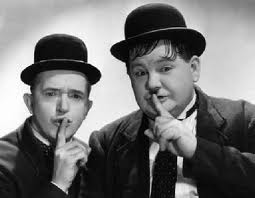
Stan Laurel insisted on in it in the early films he did with Hardy. 


Later he allowed very light shadows on one side. Other actors in their films were allowed to have deeper shadows, but not the two stars.


Still later, they were forced to use the same stark lighting that dramatic actors used. By then, producers were insisting that comedy people conform to dramatic rules.


By luck or intentional skill, early TV used the kind of flat lighting that we saw in some silent comedies. It made everything more funny. 


Lighting wasn't the only thing that was funny in early TV. The sets were funny too.  You can see the influence of old silent comedy staging.   


Me, I think that ignorant composition is bliss.


BTW: Mike's the biggest Laurel and Hardy fan that I know, and he wrote the following comment: 

"When Laurel & Hardy - whom I revere - left Hal Roach Studios in 1940 to move to 20th Century Fox in '41, they seem to age 20 years overnight. This was the direct result of the new studio's intrusive and insensitive meddling with the team.

Fox, who seem to have been as determined to ruin Laurel & Hardy as Paramount was to ruin Popeye (and MGM was to ruin Keaton, Our Gang and the Marx Brothers), insisted on uniformly realistic makeup and lighting in all their films. It didn't matter if it was a drama, musical or slapstick comedy - an approach about as individual as a cookie cutter.

Laurel instinctively knew the team needed stylization to be believable in the special world they created and inhabited. Besides keeping them young - and preserving the comic illusion that they were overgrown children - the subtle clown-white makeup the team had been using since their silent film days also kept them slightly cartoony, and that much more removed from harsh reality. Stylized sound effects, lively music and flat lighting accomplished the same feat, exactly what the team needed, and had had at Roach.

Of course, the front office couldn't resist tampering with the scripts as well, and their literal, assembly line, sausage factory approach was exactly opposite to what L&H had been used to up until that time. These are just some of the reasons why the boys are still delightful to watch in Saps as Sea, their last film shot at Roach in 1940 - and already old and tiresome in Great Guns, their first one made at Fox only one year.

Unfortunately, corporate interference with creative artists is just as destructive now as it was then. In the words of Scotty Beckett: 'They'll never learn...' "


Friday, January 21, 2011

TWO VERSIONS OF "PORKY IN WACKYLAND!"


Wow! I discovered this on YouTube: it's Clampett's original Wackyland cartoon, side by side with the later color remake by Friz, "Dough for the Do-Do." Many thanks to "wecanstopnwo1" for taking the trouble to post the cartoons this way. It makes it lot easier to compare and learn from.

Of course, the original black and white version is better, that's obvious. The reason for comparing the two is that the same mistake in BG styling that's in the flawed color version is still with us today, all these years later: The color backgrounds aren't funny. No doubt producers believe that it's not the BG artist's job to be funny, but that's a mistake. Producers need to know that funny people are needed in all aspects of production, including backgrounds. Come to think of it, I wish they'd undertake more projects that would require funny people.

The newer BGs are technically more polished, but they're too literal, too unimaginative, too lacking in humor. Also, the color version horizons are too high. Why all the wasted space in the foreground? It's more ignorant, and therefore more funny, to place the character lower in the scene in a graphic-intensive story like this one.

I also like the newspaper strip feel of the earlier backgrounds. I'm seeing hints of Sterrett, Gross, Seuss and even a little Smokey Stover in the original BGs.


I like the way B and W Porky's plane is lower (and more ignorant) in the frame when we first see it, and I like the demented row of B and W trees more than the colored mountain silhouettes in the next scene.  The first time we see the Wackyland sign on a long shot (above) works better in the B and W, and the path the B and W sign is sitting on is more dynamic and ignorant, as are the trees.


Check out the next scene, which is a close-up of the sign (above). The energetic lettering and tonal contrasts in the B&W version make the scene funny, even with no animation. The color sign, on the other hand, is simply information. What a pity that this film fell into the hands of a humorless designer!


Well, a full comparison would take up too much space. I'll just close with one more point, which has nothing to do with backgrounds: namely that black and white is easier to make funny than color. It shows off funny drawings better. You'd never wish that Clampett's "Coal Black" and "Great Piggy Bank Robbery" were colorless, but aren't you glad his "Porky's Surprise Party" (above) was done that way?  Good old Bob! He doesn't get credit for it, but he developed two successful styles, the first one for the better cartoons done by his B and W unit.