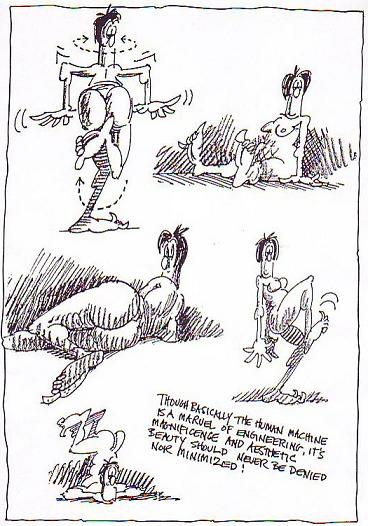
Sorry I cut off Power Weasel's feet. My scanner has a small platten.


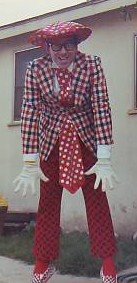
 I'm kinda busy tonight so I'll have to put up Mike's pictures tomorrow. I think you'll find it worth the wait. Meanwhile here's some Uncle Eddie photos taken in the backyard of my first house. John needed some pictures so he could try to sell me to TV as a cartoon show host.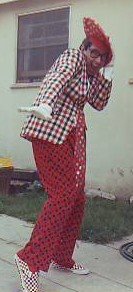


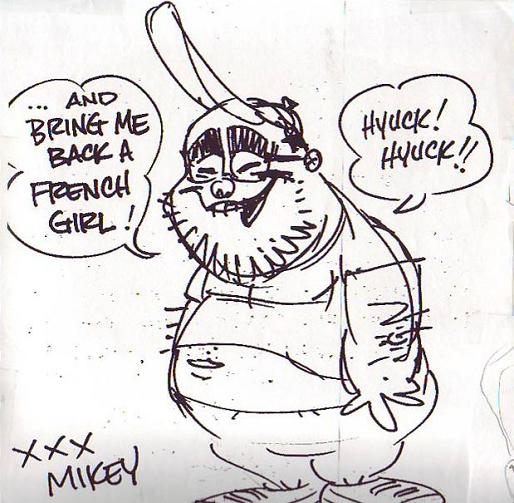 It's about time I paid tribute to a terrific artist and a good friend, Mike Fontanelli. Mike is an awesome character designer, a phenominal writer and gag-man, an ace director, a hilarious caricaturist and a legendary oogler of women. The designs on this page were done for Tiny Toons, which was his first character design gig. In other words he did these drawings when he was raw, almost right out of the starting gate. He's even better (and much thinner) now but I don't have his recent work at hand so these will have to do.
  Mike grew up in Brooklyn and went to the School of Visual Arts where he studied with Will Eisner. After SVA Mike got a job in a New York book store while he tried to figure out what to do next. While there he did some free drawings for a small-circulation fan magazine which somehow made its way to Los Angeles where Bruce Timm saw it and showed it to John K. John immediately called him and offered him a job. He even offered to pay his plane fare out to LA. The rest is history. Boy, it pays to get published, even in small venues! You never know who might be watching!
 This drawing of Buster Bunny (above) is an interesting one for a couple of reasons. Look how happy and energetic it is! It just oozes charisma and appeal! And take a look at the clean-up line. The thick-and-thin is exquisite! Then there's the bear with human feet below.
 Now all these years later Mike is a rich, ascoted bachleor living with his cheetah and fine art collection high atop a penthouse in Beverly Hills. Really, Mike is carried around everywhere by an army of naked butlerettes. We still eat pizza together but his tasters have to have the first bite. OK, I'm exagerrating just a bit.
 When I first got into the industry I was really impressed by some of the animatics I saw. I remember thinking, "Gee, you don't need to animate some of this stuff! The story is interesting even without animation! And without animation there'd be more time and money to make the drawings really good!" I remembered how much I liked "Crusader Rabbit" when I was a little kid and that was nothing more than a Leica reel. "Roger Ramjet" and "Astro Boy" confirmed the idea.
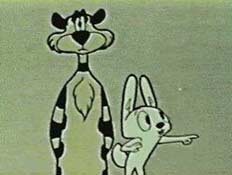 So how does the rest of the animation industry compete with this? It seems to me that the natural way to compete with innovative still drawings is to create innovative moving drawings. That's what John did with "Naked Beach Frenzy," possibly the funniest cartoon made in the last half century. Funny moving drawings require a new way of writing stories. The stories actually have to be funny and they have to lend themselves to the type of humor that funny artists like to draw. Good plots may be less important than good opportunities for funny drawings. Well, it's a big subject and there's no space to cover it here.
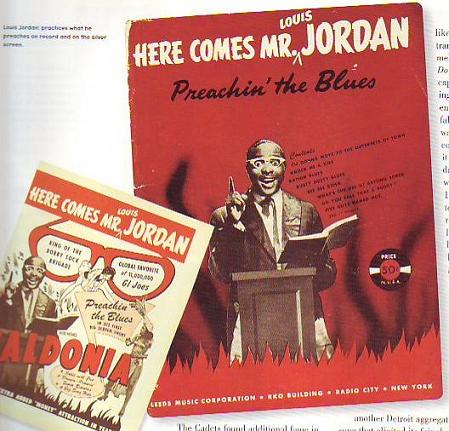
 I wish I could remember the name of the library book I got these pictures from. Maybe it was a history of rock & Roll. Anyway, what do you think of them? I love the picture of the Jitterbug musicians on top. Is that Duke Ellington on the left? No, it couldn't be, he'd be older. The guy on the right is surely one of the happiest people ever captured by photography. I know how he feels. It's a great feeling to get some drastic new threads! Other musicians and vocalists (below) include Louis Jordan, Nathaniel Mayer, Little Richard and...who are those 70s guys?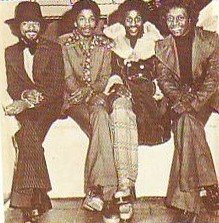


 You don't need a crystal ball to see that anime is poised to make a big impact on the American market, even bigger than it's made so far. Somewhere down the line someone will make the breakthrough anime that'll push Disney and Pixar off the map. It's only a matter of time.
 Me, I'm not an anime fan. I know there's been some good stuff done in that medium but there's also an awful, awful lot of kitch. I mean big, hulking mountains of it! All the cute girls with gigantic, cute Bambi eyes, cute and oh so precious hairstyles, and cute little outfits with cute little boots... Cute! Cute! Cute! Even the guys are cute! Man, I'm getting a sugar overdose here!
 And how do you like anime plots ? "Ganzu, the cute princess of cutania must get the power ring back that was stolen by Power lad and his Power Pals. A fight ensues with Power Lad shooting power beams at the cute girls and their cute, fuzzy little animal friends. Eventually Power Lad and his Power Pals realize the've been manipulated by the evil Ganzuni. Another power beam fight ensues with the cute forces in beautiful outfits joining with the powerful Power Pals (also in cute outfits and hairstyles) against Ganzuni. The good guys win. " Aaaaarggghh!!!!!
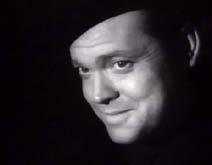
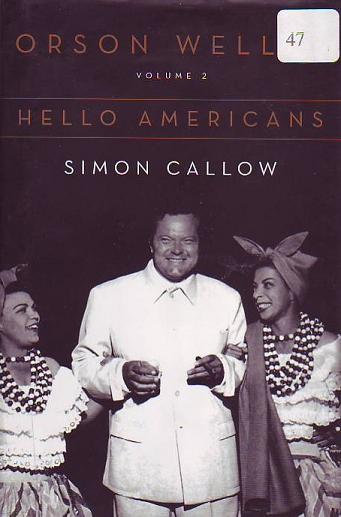 Here it is, the second volume of Simon Callow's biography of Welles. I've only just begun it so I really shouldn't be writing about it so soon. I just can't help it, there's so many interesting things in it. Please forgive my writing and probable typos. I have to write this fast with no time to edit.
 Here's an example (above) of the kind of narrative prose Welles liked to write. I knew I'd seen the style before but I couldn't place it until now: it's from Psalm 23 in the King James Bible. In that Psalm each line is split in two: " The Lord is my shepherd / I shall not want. " It's the only poetry in the English language that might surpass Shakespeare, in fact some say that Shakespeare wrote it. Almost every line is two or three simple thoughts jammed together with a natural pause between each thought...it's a very powerfull type of prose. Very noble, very musical.
I've only read a dozen pages or so. When I put it down Callow was relating the story of how Welles rehearsed the actors in "Magnificent Ambersons." He recorded the rehearsel on records then played the best parts back when it was time to film it. Welles thought actors always spoke their lines too slow infront of the camera and he wanted to remind them how good it sounded when they spoke fast in rehearsel. Callow thought it had the unexpected effect of making the scenes feel awkward because the actors couldn't find the natural rythym of the present, infront of the camera.
Welles put a lot of emphasis on the reading that was done in rehearsel. I'm proud of myself because I deduced this before I ever read it, in fact I did a blog entry about it. You can hear it in the way he delivered his lines in " Jane Eyre." The lines sound like they're being read! You might think that would be a liability but it wasn't. It sounded great that way! I read ahead in the Jane Eyre sequence and discovered that he walked on the set and started directing from a podium just like a conducter, even though he was only hired to act.
 I spent another afternoon sketching Milt Gross pictures at the ASIFA Archive in Burbank. Once again I'm indebted to Mark Kausler and Steve Worth for making this possible.
 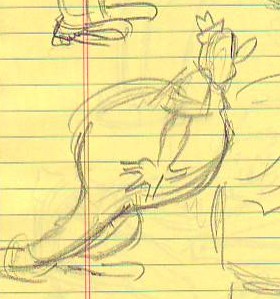 How fearless Gross is! The guy (above) doesn't fall, though he's leaning and is painfully top-heavy. He doesn't fall for the perfectly logical reason that it's funnier if he doesn't.
 I love Gross' walks. Strides like this (above) just beg to be animated funny.
 This ball-throwing pose (above) probably worked better in print than it would in animation. Even so, the way the forms squash into each other certainly is interesting. Animators shouldn't be put off by the flat, print bias of the pictures. Even the flatest ones are terrific conceptual blockbusters.
 Over the weekend I did some housecleaning and found some books I thought I'd lost. One of them was a terrific book on military tactics. Most of the people who visit here probably aren't interested in this sort of thing but I can't resist relating one of the stories in the book, dealing with Napoleon's famous Italian Campaign.
Before I dive deep into the well of theories again I want to comment on a critical internet article about John K and Clampett which appeared a couple of days ago, and which was linked to without comment from Cartoon Brew. The article made me pretty upset but I'll try to respond with restraint since the author seems to be a nice guy and tried to be fair in his own way.
First off, I was disappointed to see Clampett's work described as crazy, crude and exagerrated. He certainly was all these things (I'm assuming "crazy" was used affectionately) but it seems stingy not to add that he was also crucially inventive and highly entertaining. Sergio Leone, Fellini, Mick Jagger and Elvis were also crude and exagerrated at times. So what?
Clampett's style was summarized as having to do with bulging eyes and rubber-hose limbs. That's OK so far as it goes but where's the rest of the list? I didn't see any mention of Clampett's innovations in comedy, acting, pacing, animation, cartooning, dialogue, editing, and musical application. It's so strange to see the man's whole ground-breaking effort reduced to a couple of insults.
John K got the same harsh treatment. John's work was characterized by naked boobs and farts. Poor John gets no credit for the uptillion drawing, story, dialogue, editing, pacing, acting and musical innovations. The author casually reduces this bulging warehouse of gifts to the animation industry down to...boobs and farts. At the end of the piece he condescendingly pats John on the head by conceding that the pathetic purveyer of farts at least stimulates discussion about animation. Unbelievable.
Now I'm willing to concede that everyone isn't tempramentally suited for outrageous humor. If you don't like that sort of thing, or can only take it in small doses, then it's natural to resist people like Clampett and John, regardless of their innovations. Maybe it's even natural to nitpick about whatever faults they have. That's OK, I understand that. Just be respectfull when criticizing people who are giants in their field. We need these people and they're getting frightningly scarce.
 Did the latest Wallace and Gromit film, "Curse of the WerRabbit," steal portions of a character design from "Tales of Worm Paranoia?" Here (above) is the suspicious design in the W&G film.
 Here (above) is Sally Worm from "Tales of Worm Paranoia." See any similarities? It's probably a coincidence but it makes me wince just the same.
 This is a blog about sleep and I thought you guys would rather see these girls on a bed than me. Anyway here's the story.
 I was tired and in order to get to sleep I fantasized about being at a party. Of course the girls at the party all thought I was incredibly sexy and the guys all thought my ideas were brilliant. As the party progressed and my real body came closer and closer to sleep I began to wonder if the dream couple near me were saying things that I hadn't scripted. I thought I was imagining it at first, after all it was my fantasy and people had to say what I wanted them to say. After a moment I realized that I wasn't imagining it. They were speaking independently and it was really bothering me. Then I noticed what was happening to the furniture!
 Has everyone here seen John Kricfausi's latest (or nearly the latest) blog entry about his artistic influences? If you haven't then you missed the mother of all animation posts. I predict that copies of that article will be passed around for decades, it's that good!
 Question #1: Does the girl like her dad? Scott will only date women who like their fathers. He reasons that if a girl feels mistreated by her dad she'll spend the rest of her life making other men suffer for it.
 Here's (above) Manet's famous Olympia painting. It's said to be the painting that began modern art. If that's true then I'll concede it's historical significance but that doesn't mean I have to like it. The lighting is flat, the head looks grafted on, the body is just a line drawing which makes almost no impression on the bed and the woman is sterile and uninspiring. I like most of Manet's paintings but this Mel Ramos-style pop art just doesn't do it for me.
 This (above) is a famous Carravagio. I don't like the man. He's a good technician but he has no soul. David Hockney thinks this picture was painted using projection optics and I'll bet he's right. And has there ever been a more bored, kitchy and uninspiring model in the history of fine art? Alright, there's "Olympia" but I'm not counting her.
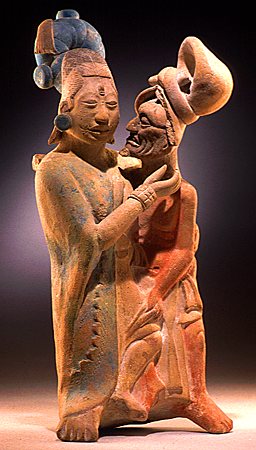 I'm amazed at how often funny sculptures appear in collections of Pre-Columbian (i.e., before Columbus) art. The pictures I've been able to post here are just the tip of the iceberg. They get a lot funnier than this. The L.A. County Museum of Art has a terrific collection of funny, Virgil Parch-type sculptures, some of them more than 1500 years old. I'll post some pictures whenever I can find some good ones. You'll laugh out loud when you see them.
 It's disconcerting to think that the earliest known peoples to appreciate formal comedy might have been the Central and South Americans. Among the 4 or 5 major nations only the Aztecs seemed to be serious and straight-laced about art. The others got jokes in every chance they could.
 Maybe ancient South American comedy isn't better known because serious South Americans of the present are embarrassed by it. Or maybe the scuptures just don't seem like high art because they're funny. Anyway, my advice to time travelers going back to the golden age of that continent is to carry plenty of whoopee cushions and joy buzzers.