
 The guilt is eating me alive! I know I promised not to do another "Mildred Pierce" post, and I know that fewer than 1% of the people reading this have access to the film...or even care about it. I'm sorry, but I've just gotta write about this thing anyway. I can't help myself! I'm obsessed! Pity me!
Anyway, as I may have said in a previous post, the story is about a mother who works her fingers to the bone to give her daughter a highbrow education, then the daughter rejects her for being low class. It doesn't sound like much, but the screenplay is terrific and James Cain, who wrote the novel the film is based on, is a really significant writer who even now is underappreciated. Maybe that's because some of his books are so flawed.
 I read "Double Indemnity" and was amazed to see to see that Cain gave his brilliantly-conceived characters the short shrift and spent most of his time on trivial details of the crime. I also read the novel of "Mildred Pierce", and that had the same problem. Once again the characters and situation were brilliant, but Cain didn't know what to do with them. That's OK. He was still a brilliant writer.
Jerry Wald, who produced the film, wanted to flesh out the talky Cain story and add a murder. He'd just seen "Double Indemnity", which was a wildly successful Cain adaption, and since that had a murder in it , Wald figured Mildred should have one too. He also had the notion that you can combine women's melodrama with noir crime, something no one else had done before (though D. Indemnity and "Laura" came close). Wald was trying to create a new genre.
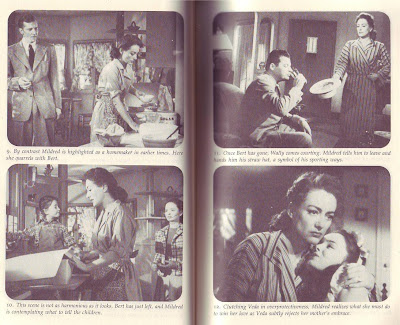 He had six famous writers (one of the was Faulkner) take a shot at it before he got what he wanted. It was frustrating because combining two separate genres isn't easy and he didn't know how to go about it. He just had a feeling that he'd know it when he saw it.
Sometimes he had three writers working simultaneously and completely separately on the same project, a practice that makes writers furious. One writer "broke the spine" of the improved story, but was too slavish to the book in the details. Two others added too many fantastic and implausible elements, and made the story too long. One made the story too violent. Wald believed melodrama couldn't support too much violence. One murder was enough.
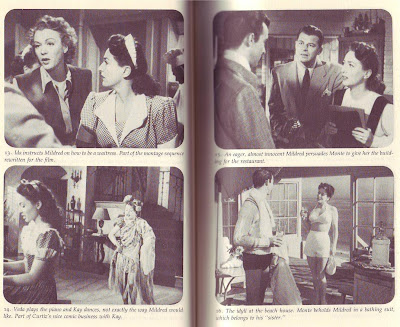
Finally he had enough interesting scenes to make a good story. Every writer contributed something of value, but it was still too long. With the shooting date approaching he took the bold step of getting a radio writer to condense the story. Radio people were experts at telling long stories in short formats. The radio guy, Ranald MacDougal, accomplished miracles and tied it all together deftly.
At one point in the story Mildred marries a guy and one minute later -- one minute! -- she decides to divorce him...and it works! Now that's compression! MacDougal did it by making the audience hate the guy and want to see Mildred divorce him. We're actually impatient to see Mildred dump him and when she does it, after only a minute of screentime, our only reaction is "Well, it's about time!" MacDougal actually makes the guy appealing in certain other parts of the film, he just emphasized the negatives in this section to smoothe over the story compression. Wow! Is that expert writing or what!?
I forgot to add that Wald hired Curtiz to direct the film, which was a brilliant choice. Curtiz injected humor into the story to smooth over the sometimes fuzzy logic, and it worked beautifully.
I'm not aware that Jerry Wald did anything else that was particularly distinguished, but in 1944-5, when Mildred was made, he was definitely cooking with gas. The womans' film/noir synthesis he created is now one of the most common types of film.


 After a couple of years it dawned on me that I might invite one of my girl admirers to take a ride. You know, give her a thrill. I was too young to think of doing anything else with her. Of course the girl oooed and ahhhed at everything and was much impressed. I even would let her look at my comic books and drink my root beer!
  As the years slipped by it seemed that the admiring girl more and more wanted to sit on my lap, the better to see me work the controls. It was getting hard to concentrate with all that hair and body parts next to me. I began to think that a kiss wouldn't hurt. Hmmm, that wasn't bad. Maybe if we...well, it wasn't long before we were enacting the whole Kama Sutra.


 Tell your friends! This student needs a place to hang her guitar!* **
 Fernandel: Hey, you guys like Greek philosophy don't you? Good, so do I!
 That's because Greek philosophy, which shaped the way we make arguments, never devoted much time to the defense side. The Greek philosophers arose during a time of change in Greece and their job was to pave the way for that change by attacking the establishment. The poor establishment never got it's share of philosophy.
 The best the Greeks could do for the defense side was to come up with rhetoric and oratory. Rhetoric teaches the arguer to flatter the audience and establish himself as a likable and trustworthy speaker. He's saying, in effect, "If you like me then you should like my argument. Trust me. "
 Actually the Greeks came up with another way to argue for the defense. That way was to limit the people debating to the landowners. The thinking was that people who had a financial stake in stability and tradition could be trusted not to carry attack arguments too far.

 The film is about a family who are bored and irritated by each other and who all are harboring secret fantasies about taking off on their own without even a good-bye. One of the only things they all have in common is that they’re all quietly moved in some way by the earnestness and innocence of the youngest kid. The girl isn’t Shirley Temple. She’s plain and awkward and doesn’t have witty lines. She’s just good-hearted and sincere.
 Everybody in the family wanted to leave and start fresh somewhere else, but the audience knows what the family doesn’t, viz, that they’d probably do even worse on their own. These are luckless people who are doomed to experience tough times and disappointment. That happens to some people. What they don't realize is that life could get even worse. They don't know it but the only chance they have for even a small amount of happiness is to dig in and be loyal to each other.
 Having a kid of your own fills you with awe several times a day. If you're adventurous, and especially if you're an artist, then you need that awe to recharge the batteries. For me that's the message in this otherwise irritating film.


